
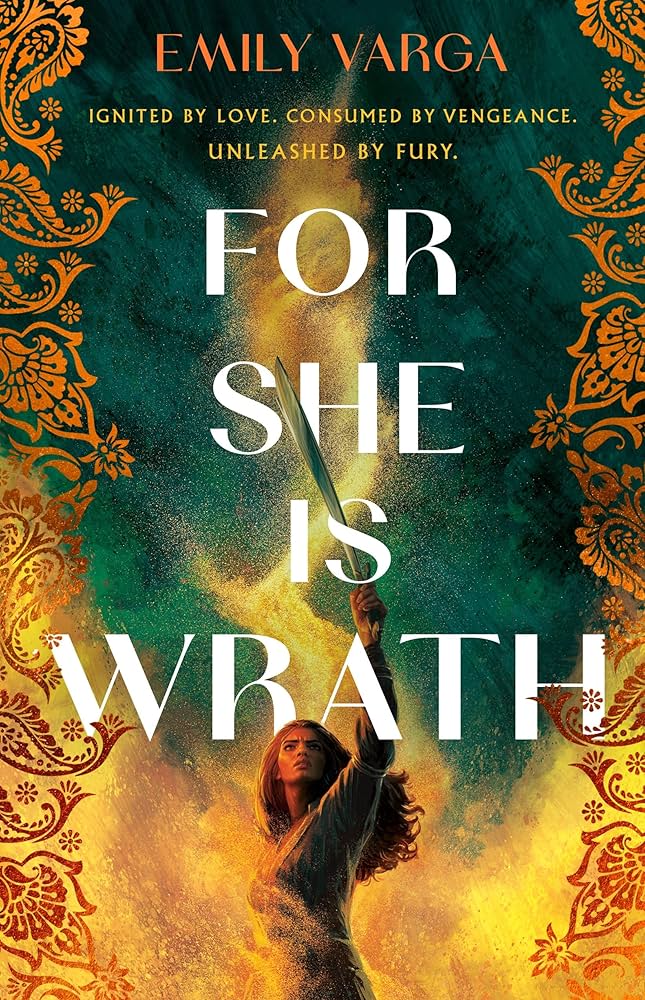
For She is Wrath by Emily Varga is well-crafted, engaging, and clever. Part Pakistani djinn myth, part Count of Monte Cristo retelling, this story follows Dania, the daughter of a renowned swordsmith and a wrongly-convicted traitor and murderer, as she escapes a high-security prison with the help of her new and unexpected friend, Noor, who was also wrongfully imprisoned. Both set on revenge, they quickly discover a common enemy and set out as partners.
After they uncover a coveted treasure, the pair make their way toward the capital with a plot to tear down the empire. But once they establish themselves in the city, Noor and Dani face the enormity of their revenge and are forced with every step forward to question how far they’re willing to go and how much of themselves they’re willing to give to their revenge.
To make things more complicated, their plan involves using the emperor’s most coveted resource, djinn seeds, which is a crime to possess outside the emperor’s regulation since it can be mixed into solutions that offer temporary magical abilities. Dani uses them to become a foreign noblewoman named Sanaya as a way to disguise herself from those who would otherwise recognize her. However, the power she’s using has side effects, and the more she uses, the less she can identify whether her actions are her own. Especially when a true djinn shows up and offers her the power she’s been seeking to enact her complete revenge at a price she knows she shouldn’t accept.
***
This is a solid 4-star book. Part of this rating is regarding how well-executed I think the retelling is (phenomenal), in addition to characterization and writing (also great, but not mind- or genre-shattering, which is what I reserve 5 stars for).
As with any retelling, the plot is mostly set in stone and the characters’ decisions are mostly made for them. Something the author does to offset this is to combine or remove characters from the original story in a way that keeps the reader guessing and also distills the story into less moving parts to focus more on the tensions between and within characters. But the book lives up to its genre, romantic fantasy, and is just as typically formulaic and predictable in those respects, even where it deviates from the original story. Alongside the strong themes of forgiveness and redemption, this story’s conclusion seems almost inevitable.
For me, this story stands out not only because of how it changes the Count of Monte Cristo from a romantic French adventure to a fantasy Pakistani folktale, but also because of its imaginative use of characterization.
Each character is offered redemption and given a reason to say yes. There are no heroes or villains in this story, only people who make good or bad choices and learn to live with themselves in the aftermath of their decisions.
Dania and Noor challenge each other at almost every step to continue their revenge. They each have doubts and lean on the other to reassure their decisions and remind them of why they chose this road. All the other characters stand alone in their decisions, which is notable for how the story unfolds.
Dani and Noor’s main goal is revenge on those who have wronged them: Casildo, Dania’s father’s friend who betrayed him to his death; Darbaran, the guard who arrested Dania; Vahid, the emperor who killed Noor’s father in search of missing djinn seeds and wrongfully convicted Dania to cover his own political actions; and Mazin, Dania’s childhood best friend and lover who betrayed her into the hands of Darbaran and Vahid without a hint of remorse.
The story builds comparisons between the before and the after of Mazin’s betrayal: the before is a collection of scenes of Dani and Maz scattered strategically throughout the book, giving the reader not only the key parts and experiences of their relationship but also offering noticeable reflections for things each of the characters say or do in the present that adds depth to their interactions and characterizations. These comparisons also serve to build tension and conflict, as each scene between them, whether before or after his betrayal, adds a layer of familiarity and longing for something neither of them are sure is possible after what happened.
For the trope fans: this book has found family, hidden world, first love, friends to lovers, enemies to lovers, forced proximity, second-chance, one bed, status imbalance, and “who did this to you.” There may be others, but I am not a trope girlie, so forgive me if I missed some.
A few things the book is: enjoyable, imaginative, well-written, full of scathing and flirtatious banter, full of dark magic and betrayals, and a collection of themes such as revenge and forgiveness, obligation and freedom, self-actualization and self-annihilation, and grief.
A few things the book is not: unpredictable, spicy, difficult to read, full of cliches, of characters with healthy mental states, and of happy families.
My favorite thing about this book is its constant mirroring. This occurs in almost every facet of the story: themes, character development, settings, scenes, and even narrative lines.
My least favorite thing about this book is how much it follows the same storyline as The Count of Monte Cristo. For all its deviations and added twists and fantastical elements, there are so many scenes and developments that are taken directly from the source material. Yes, I know it’s a retelling, and I really appreciate how it’s reimagined, but the more I remember about Dumas’s book, the more I realize how closely this story follows that one.
That may be a bonus for some people, and I don’t mean to say that it was done poorly–I don’t believe it was–but I would have liked a little more deviation from the plot and storyline.
Ultimately, this book is a fun twist on The Count of Monte Cristo featuring strong females, a compelling love story, and a cast of almost entirely morally gray characters, which I will always stan.
Thank you to Wednesday Books for giving me the opportunity to read this book as an ARC on NetGalley. This book is due to be published on November 12 this year and is well worth the read. It took me three days to read, and that was only because two of those days were work days. I think if I had started on a weekend, I could have finished it in one (and this is from someone who has been in a suspiciously long book slump).
I follow the author on TikTok and was so excited to see her book available to review. She’s been teasing it for some time and seems like such a lovely person.
Scroll to the bottom of the page if you don’t want any spoilers but want to like, comment, or subscribe.
Thanks for reading!
***SPOILERS***
Below is an additional, more in-depth thought on plot and characterization. If you’re unconcerned by spoilers, read on.
I really appreciate the way the author gives Dania and Mazin mirrored redemption arcs. It’s beautifully done and a good way to add depth to Mazin’s character instead of placing him in the awkward “romantic lead only” position. It also underscores everything Dania is doing by forcing her to confront where her decisions will lead and who she would become if she continues her path of destruction. Especially since it answers a question she’s refused to answer for herself since the beginning.
***End Spoilers***
Comment below if you’ve read the book and have thoughts on my review. Like and subscribe to receive notifications on more reviews and other postings!
 Unscripted Endeavors
Leave a comment